
Bahrain Import Rules and Compliance for Bulk Vape Coils and Vape Hardware

The Bahrain Import Playbook for Vape Coils and Hardware: A Practical Path to Fast, Compliant Clearance
Importing vape coils, pod systems, batteries and accessories into Bahrain is perfectly doable—if you treat compliance as an operational discipline, not an afterthought. The market moves quickly, and delays at Customs or a surprise Ministry of Health (MOH) query can wipe out your launch calendar and disrupt retailers who depend on predictable replenishment. ⏱️ 6-min read
This playbook is written for importers, wholesalers and online vape retailers who want a step-by-step approach that minimizes risk. You’ll map the agencies to consult, classify your products correctly, assemble the documentation that actually gets shipments released, and build the testing and last‑mile practices that let you scale without drama. The goal is simple: land inventory on time, every time—and pass a regulatory inspection on your busiest day without breaking stride.
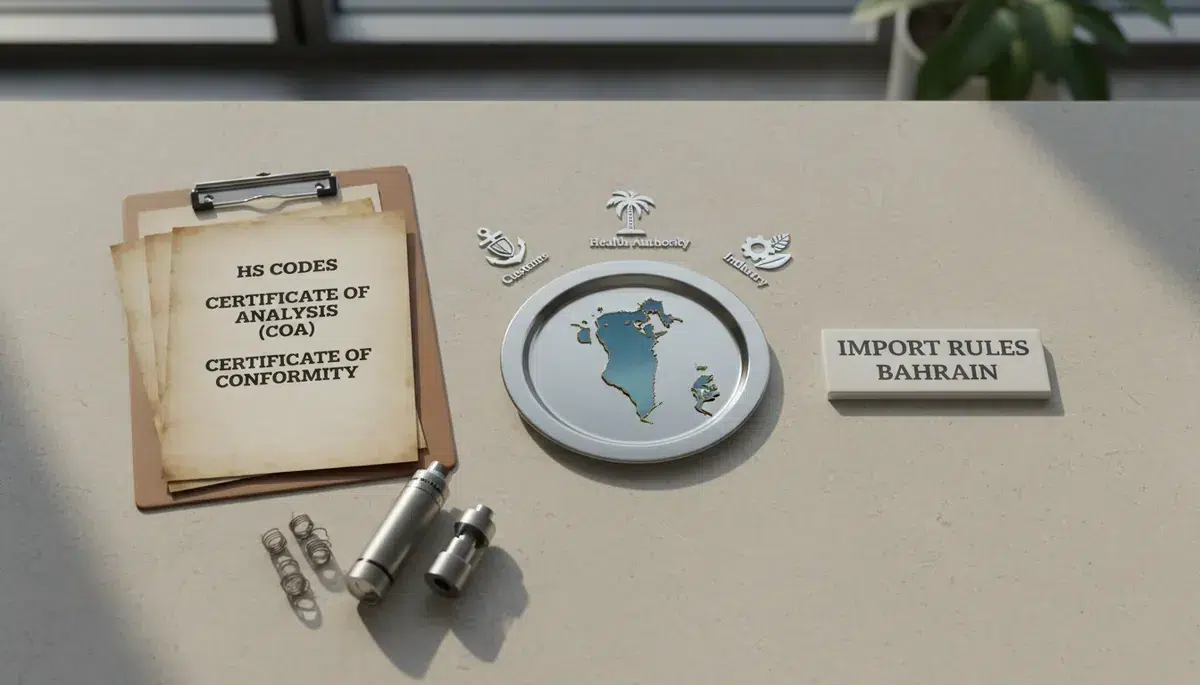
Map the regulatory landscape and authorities to notify
Bahrain’s vape supply chain touches multiple regulators. Understanding who enforces what—before you place a purchase order—prevents crossed wires and last‑minute scrambles. Start with Bahrain Customs Affairs, which controls HS classification, duties, and the clearance process at Bahrain International Airport and Khalifa Bin Salman Port. Customs will look to your invoices, packing lists and product descriptions to determine tariff treatment and whether additional authorities should be involved. A clean customs file is the backbone of a smooth import.
The Ministry of Health (MOH) sits at the center of product safety for anything that contains nicotine or is marketed for inhalation. Expect MOH to set testing expectations, review nicotine content declarations, and enforce packaging and warning standards. If your shipment includes pre‑filled pods, e‑liquids, or devices with pods that may be construed as nicotine delivery systems, plan for MOH involvement and pre‑import notification where required. The National Health Regulatory Authority (NHRA) or specialized public-health units can support MOH on product registration and market authorizations, especially for consumables or integrated devices.
Commercial activity and product standards run through the Ministry of Industry and Commerce (MOIC) and its Standards & Metrology functions. Your business needs a valid commercial registration with the appropriate activity codes to import and distribute these categories. Standards-wise, Bahrain aligns with Gulf (GSO) norms; in practice, that means your electrical goods and batteries should be backed by recognized test reports (for example IEC‑based standards) rather than relying solely on marketing marks. When in doubt, your local standards contact under MOIC can confirm which technical files or certificates Bahrain Customs expects at the border.
Finally, remember transport regulators and carriers. Air shipments that include lithium cells or packs are subject to the IATA Dangerous Goods Regulations, enforced operationally by your airline and ground handler. Carriers will ask for UN 38.3 test summaries and correct DG documentation; they will refuse or delay non‑compliant cargo without hesitation. Coordinate early with your freight forwarder so the customs and safety tracks run in parallel instead of colliding on arrival.
Classify products and confirm tariff/HS codes
Accurate HS classification is more than a paperwork exercise—it drives duty rates, determines whether excise or public health controls apply, and sets the tone for inspection. Misclassification is one of the fastest ways to trigger a detention. Treat each SKU on its own merits and document how you reached your classification conclusion, so you can defend it if queried.
Break your shipment into logical groups and consider likely headings, then validate with Bahrain Customs before you ship. Replacement coils—assembled heating elements with wire and wicking materials—are typically treated as parts rather than complete devices and may fall under “parts” provisions for electronic apparatus. Rebuildable atomizers (RDAs/RTAs) and tanks are mechanical assemblies; if they lack electronics, they may be treated differently than a regulated mod with control boards. Fully assembled devices with circuitry often classify to “electrical machines and apparatus, having individual functions” headings, while chargers, cables and wall adapters fall under electrical equipment chapters (for example, power supplies and battery chargers). Lithium‑ion cells and packs are typically classified under battery headings, but treatment differs for loose cells versus packs or batteries “contained in equipment.”
One critical nuance: international tariff schedules have evolved. Many jurisdictions adopted HS 2022 changes that introduced a specific heading for nicotine products (including e‑cigarettes and refill containers). Confirm whether Bahrain’s current tariff applies this heading to finished devices, consumables, or parts. If your product is marketed as a nicotine delivery system—even when shipped without e‑liquid—classification may steer authorities toward tobacco‑substitute controls with higher scrutiny or duties. Conversely, dry coils or empty hardware marketed strictly as parts can, in practice, clear faster under parts/electrical headings when your documentation is precise.
How to validate your call: assemble a technical sheet for each item (materials, function, presence of electronics, whether any liquid is present), propose your HS code with reasoning, and ask your licensed customs broker to pre‑consult with Bahrain Customs. If you ship regularly, request a written classification comfort (ruling or email confirmation) to keep on file. This upfront investment pays for itself the first time an officer inquires why a coil was not declared under a nicotine heading—you will have the logic and local sign‑off ready.
Required import permits, documentation and customs process
Your core customs pack should be flawless. Prepare a detailed commercial invoice with clear commodity descriptions, proposed HS codes per line item, unit and total values, currency, Incoterms, and batch references. Pair it with a packing list that maps SKUs to carton IDs and weights; a bill of lading or air waybill; and a certificate of origin if your supplier’s country of manufacture affects tariffs or trade preferences. Keep your Bahrain importer registration and tax details up to date so the declaration can be lodged without administrative hiccups.
Where health or product permits are in play, front‑load them. If your shipment includes pre‑filled pods or e‑liquids, MOH may require an import licence or formal notification accompanied by product dossiers, safety data sheets, and laboratory Certificates of Analysis (CoAs) showing nicotine content and key impurities. Even hardware shipments with no liquids can attract product controls if devices are marketed for nicotine delivery; confirm MOH expectations in advance and, if in doubt, submit a pre‑import query with your broker’s assistance. Having the MOH acknowledgement in your file often shortens any hold at the border.
Build a realistic clearance path. For air freight, submit pre‑arrival filings—electronic manifest and your core documents—24–48 hours before the flight lands so Bahrain Customs can run risk assessments early. For ocean freight, push your documentation to your broker as soon as you receive the bill of lading; in many cases, you can trigger pre‑processing several days before the vessel berths. On arrival, expect potential inspection and sampling requests, especially for first‑time shipments, high‑risk classifications, or consignments including batteries. Keep accredited lab reports handy; if an officer asks for proof of UN 38.3 or nicotine assay, you do not want to start emailing overseas at midnight to chase a manufacturer’s QA manager.
Know the common documentary traps. Detentions often stem from vague product descriptions (“vape parts” is not enough), inconsistent weights between the packing list and air waybill, missing UN 38.3 test summaries for loose cells, or undervaluation that does not match market norms. Another frequent cause: bundling coils with pre‑filled pods in one retail pack without declaring the nicotine content. Avoid edge cases; if an item could be construed to contain or be contaminated with nicotine, declare it proactively and include the lab report. Customs officers reward clarity.
Nicotine, ingredients and lab testing expectations
In Bahrain, nicotine changes the conversation. Products that contain nicotine
Frequently Asked Questions
Bahrain's BH 2:2021 regulation requires a Certificate of Conformity for electronic nicotine products like vape coils before import. Importers need a valid commercial registration including tobacco trade, factory ISO 9001 certificate, product packaging with warnings, and lab test reports per GSO standards. Submit these to the Ministry of Health for approval to ensure fast customs clearance.
Vape hardware falls under BH 2:2021, needing prior regulatory approval from Bahrain's Ministry of Health. Provide business license with tobacco scope, ISO 9001 from the factory, packaging artwork meeting label requirements, and ISO 17025 lab certification. This setup avoids delays at customs for pod systems, batteries, and devices.
Key documents include a valid importer's commercial registration covering tobacco, factory ISO 9001 certificate, product packaging images with required warnings, and ISO 17025 lab reports. These ensure compliance with BH 2:2021 for clearance of vape coils and similar hardware. Health certificate confirming tobacco activity is also mandatory.
Yes, pod systems and batteries are permitted under BH 2:2021 as electronic nicotine products, subject to Ministry of Health approval. Requirements cover device safety certifications, battery standards via GSO IEC tests, and full documentation like commercial registration and ISO certificates. Personal quantities face fewer hurdles than bulk imports.
Nicotine concentration in e-cigarette oil must not exceed 20mg/ml per BH 2:2021. Bottled tobacco oil volume is capped at 50ml, while device oil is limited to 10ml. All nicotine and solvents must meet pharmaceutical-grade European Pharmacopoeia standards.
Obtain a Certificate of Conformity from the Ministry of Health by submitting test reports, ingredient disclosures, packaging specs, and importer credentials per BH 2:2021. This mandatory CoC confirms compliance with GCC standards for health, safety, and labeling. Bulk shipments of coils or hardware require this for smooth clearance.